ATLAS.

SOFTWARE INTELLIGENCE PLATFORM · NO LLM IN THE PIPELINE

Understand a codebase
before you touch it. For real.

Paste a public GitHub URL. Atlas clones it, parses it, and hands back architecture, code quality, git history, and security findings — every one traceable to an AST, a graph algorithm, or a commit log, not a model's best guess.

Engines 6 shipped Analysis 100% deterministic Tests 207 passing Status pre-release
api.py auth.py jwt.py db.py models.py tests/ ↳ 2-module cycle: auth.py ⇄ db.py ↳ auth.py — 6 incoming edges graph_builder.py → quality_engine.py — actual output shape, not an illustration
§

Every score, edge, and finding in a report traces back to something you can point at: a tree-sitter AST, a networkx graph algorithm, or a parsed git log — never a language model's summary of your code.

Sheet 01 — Pipeline

How a URL becomes a report

Five real stages, run in order, on your machine or the CI runner that validates them.

1
Clone
clone_with_history

One shallow-plus-history clone — not two separate fetches for the analysis and the git log.

2
Parse
code_parser.py

Tree-sitter builds real ASTs for Python and JS/TS/JSX/TSX — no regex guessing at syntax.

3
Graph
graph_builder.py

Imports, routes, and modules become a directed graph — the shape everything below reasons over.

4
Analyze
quality · security · git_intel

Circular imports, complexity, secrets, churn, and ownership — read off the graph and the log.

5
Report
doc_generator.py

One Markdown report — architecture, risk areas, a Mermaid diagram, recent hotspots.

Sheet 02 — Engines

What it finds

Six independent engines. Each produces structured data; none of them phone out to an LLM.

Repository Intelligence

Detects stack, frameworks, database, and deployment shape before anything else runs.

Architecture Graph

A real dependency graph of modules, imports, and routes — explorable, not just described.

Code Quality Engine

Circular imports via strongly-connected components, oversized functions, naming drift — scored.

Security Scanner

Deterministic checks for hardcoded secrets, dangerous exec, and unsafe deserialization.

Git Intelligence

File churn, bug-fix hotspots, ownership, and co-change pairs — pulled straight from git log.

Documentation Generator

Everything above, assembled into one Markdown report with a live Mermaid dependency diagram.

Sheet 03 — Interface

Paste a URL. Watch it work.

A job survives a page refresh mid-analysis. Dark mode and a fully responsive mobile layout ship too.
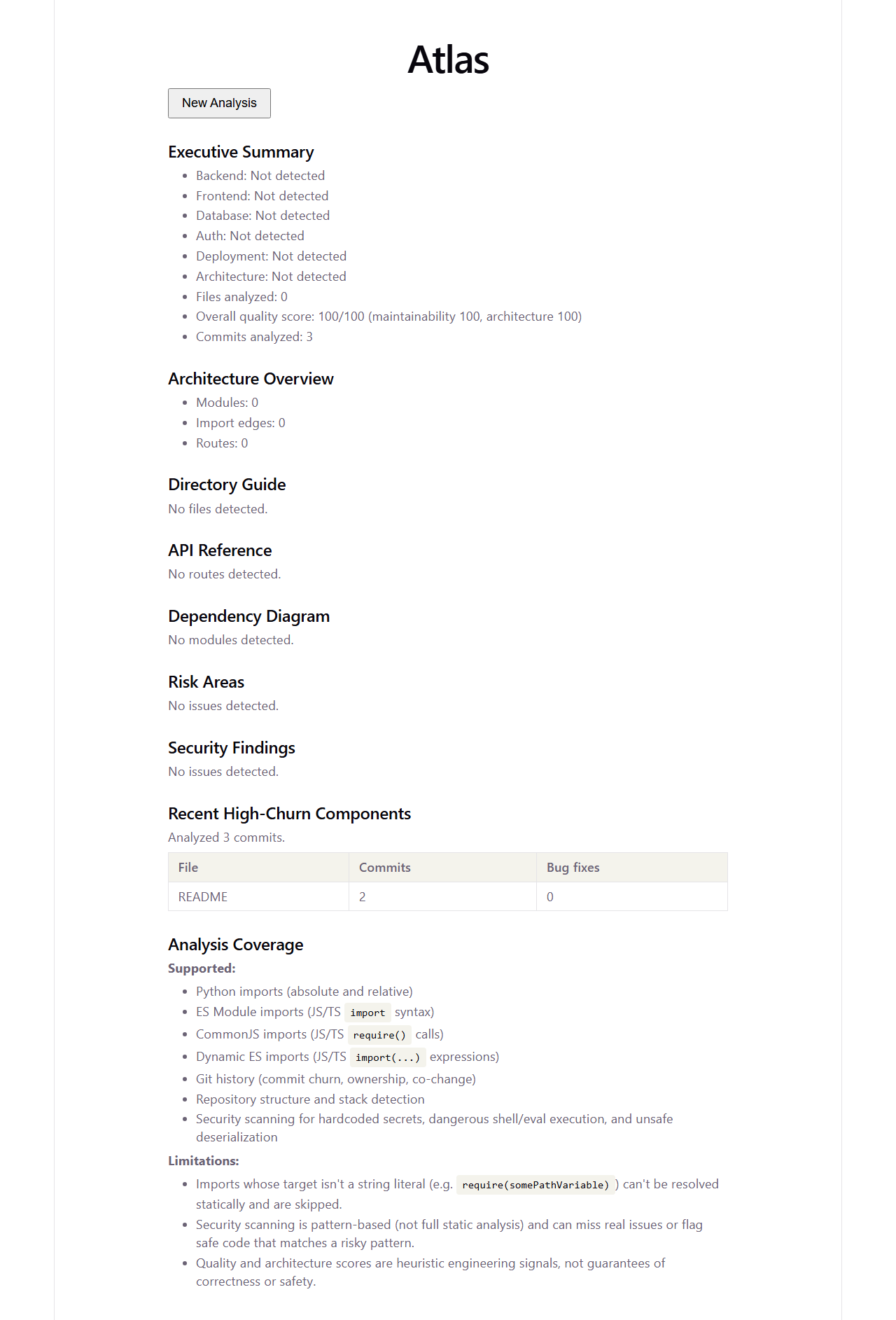
Atlas rendering a generated Markdown report, with score cards, a directory guide, and a dependency diagram.
Generated reportreport-light.png
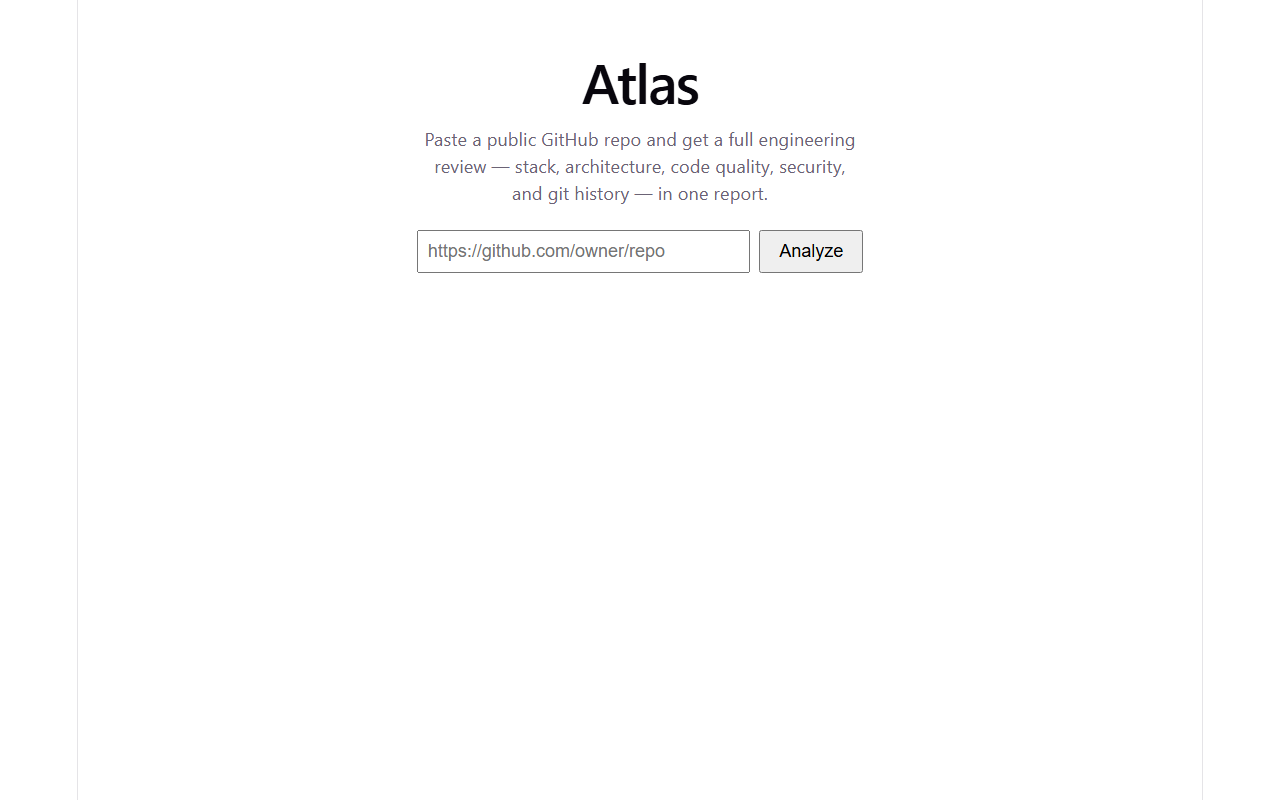
The Atlas idle screen with a single field to paste a GitHub URL.
Start hereidle.png
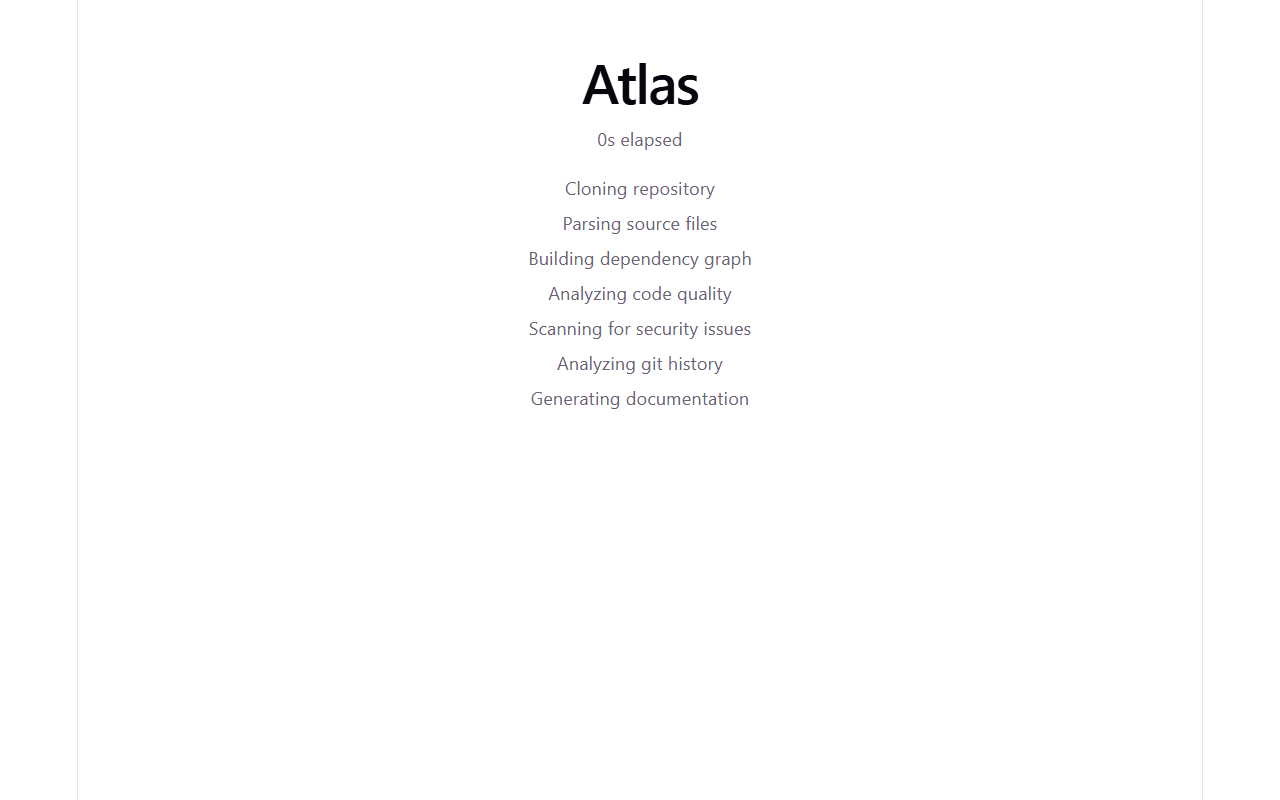
Atlas showing live per-stage progress while analyzing a repository.
Live progressrunning.png

Sheet 04 — Architecture

How the pieces fit

A stateless FastAPI backend, a SQLite-backed job queue, and a React frontend that polls it.

Clonecloner.py
Parsecode_parser.py
Graphgraph_builder.py
Quality + Security2 engines
Git Intelgit_intelligence.py
Reportdoc_generator.py

Sheet 05 — Real Output

Not mockups. Real reports, real repos.

Generated by the tool itself against public repositories, nothing hand-edited.

Six major open-source repositories, analyzed end to end — full reports, not cherry-picked excerpts:

RepoEcosystemFilesOverallCircular clustersSecurity findings
django/djangoPython3,0385617170
tiangolo/fastapiPython1,1317413
pallets/flaskPython837012
facebook/reactJavaScript4,4824222111
expressjs/expressJavaScript (CommonJS)1419802
psf/requestsPython377617
vercel/next.jsTypeScript (monorepo)clone failed — Windows MAX_PATH limit hit by test fixtures, not an Atlas bug. Disclosed, not hidden.